7 Essential Factors to Consider When Choosing a Career Path in SA
When faced with endless tertiary options, students frequently ask: What are 7 factors to consider when choosing a career? Making the right choice requires balancing internal passion with external economic realities. Here is the definitive checklist for South African students.
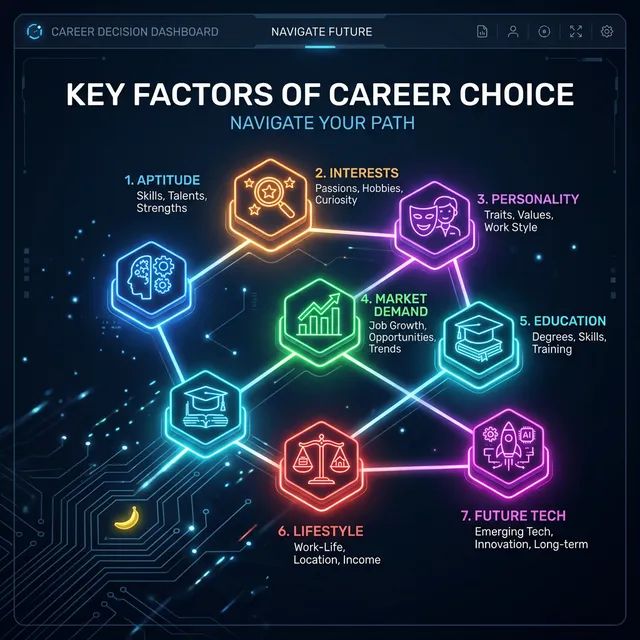
1. Natural Cognitive Aptitude
Your inherent strengths—how you process numbers, words, and spatial concepts—are the strongest predictors of your ability to master the academic requirements of a specific field. Tools like the SkillsPassport assessment pinpoint these baseline capabilities.
2. Personal Interests and Passions
Aptitude dictates what you can do, but interest dictates what you want to do. Long-term career satisfaction is only achieved when your daily tasks align strongly with subjects and activities you genuinely enjoy.
3. Personality Type and Work Environment
Are you an introvert who thrives in deep, solitary work (like a Data Scientist), or an extravert who requires constant human interaction (like a Sales Representative)? Choosing a career that conflicts with your natural personality archetype leads to rapid burnout.
4. Market Demand and Job Security
In South Africa, consulting the Critical Skills List is non-negotiable. Sectors like Engineering, Healthcare, and IT offer significantly higher job security and starting salaries compared to saturated markets.
5. Educational Requirements and Cost
Different careers require vastly different investments of time and money. Becoming a medical specialist requires a decade of study and substantial funding, whereas a specialized artisan trade via a TVET college can lead to a lucrative career in a fraction of the time.
6. Lifestyle Expectations
Consider the daily reality of the job. Does it require constant travel? Are the hours highly irregular? Ensure the career's lifestyle demands align with your personal life goals.
7. Future-Proofing Against AI
With the rapid advancement of artificial intelligence, careers based purely on repetitive data processing are at risk. Focus on fields requiring high emotional intelligence, complex problem solving, or advanced physical dexterity.
help Frequently Asked Questions
Why is structured career guidance important? expand_more
Career guidance is critical because it aligns a learner's inherent cognitive abilities, personality, and interests with real-world economic opportunities, preventing costly academic mistakes and improving career satisfaction.
Who benefits from the SkillsPassport assessment? expand_more
Grade 9 students choosing subjects, Grade 11/12 students choosing tertiary studies or TVET options, and young adults seeking to transition into the workforce safely can all benefit.
How accurate is the SkillsPassport matching? expand_more
Our matching algorithm combines scientifically validated psychometric assessments with current higher education and TVET admission criteria to ensure completely aligned and actionable study routes.

Dr. Lanette Hattingh
HPCSA-registered Educational Psychologist | Founder, SkillsPassport
Expert in psychometric assessments, career guidance, and future-ready skills development. Dr. Hattingh designed the SkillsPassport assessment methodology used by 15,000+ learners across 100+ schools.